National Human Trafficking Prevention Month: Prevention, Intervention and the Road to Recovery
TABLE OF CONTENTS
Introduction
January marks National Human Trafficking Prevention Month, a U.S. observance proclaimed annually since 2010 to spotlight one of modern society's most pervasive crimes. This month calls communities, businesses, and leaders to confront human trafficking - not just as distant headlines, but as exploitation happening in neighborhoods, workplaces, and online platforms today. The 2026 theme, "Stronger Connections. Stronger Futures," emphasizes prevention through relationships: parents talking to kids, employers training staff, neighbors watching for signs, all weaving a safety net that catches vulnerability before predators do.
Human trafficking, defined as force, fraud, or coercion for labor or commercial sex, strikes every state, with California, Texas, and Florida consistently reporting the highest cases. It disproportionately targets runaway/foster youth (recruited at average age 12–14), immigrants, LGBTQ+ individuals, and low-income women, often starting with grooming via social media or false job offers. Unlike Hollywood portrayals, most U.S. victims are citizens, not foreigners, trapped by economic desperation or family dysfunction rather than international smuggling rings. Prevention hinges on awareness: recognizing isolation, control, sudden wealth, or branding as red flags, and intervening early to break the cycle.
The Scale of the Crisis
Globally, 49.6 million people live in modern slavery (27.6 million forced labor, 22 million forced marriage). Among cases of forced marriage and sex trafficking, 71% of victims are women/girls, with sex trafficking comprising 13% of cases. Among cases of forced labor in all other industries, over two-thirds of the victims are men/boys.
- The U.S. National Human Trafficking Hotline identified 112,822 cases since inception, involving 218,568 victims (2024: 32,309 signals, 11,999 cases).
- 80 jurisdictions reported 2,640 sex trafficking and 771 labor trafficking incidents in 2023 (up signicantly).
- FY2023: 2,329 federal referrals (up 23% from 2013), 1,782 prosecutions (up 73%), 1,008 convictions.
- Top states: California (1,128 cases/2,045 victims), Texas (900/1,723), Florida (680/1,172).
- 65% recruited online; top traffickers: employers (43%), family (26%), partners (22%).
- Trafficking thrives in plain sight, facilitated by vehicles (38%), rideshares (7%), and transport hubs.
Voices Fighting Back
These leaders, from employer training programs and prevention curricula to survivor-led housing and policy advocacy, represent a full-spectrum response to human trafficking. Their work spans prevention (school systems, corporate policies), intervention (hotlines, awareness training), and recovery (long-term care, job placement). Whether scaling across 50 states or serving one community at a time, they prove multifaceted strategies work when rooted in data, survivor insight, and cross-sector collaboration.
Kirsten Foot & Businesses Ending Slavery and Trafficking (BEST): Employers as Anti-Trafficking Allies
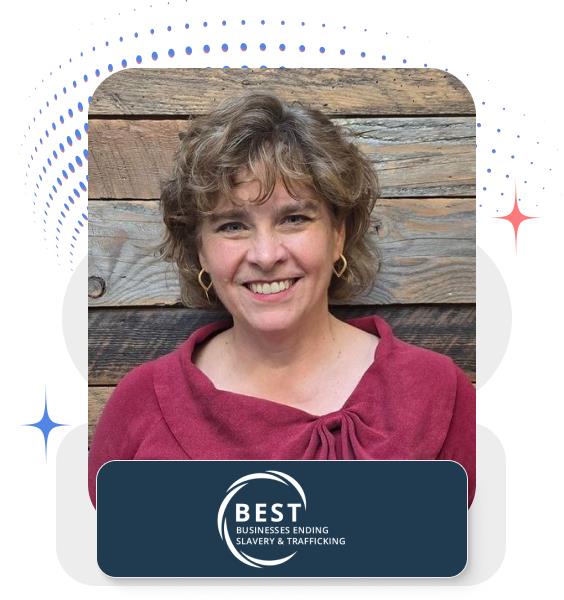
Kirsten Foot, CEO of Businesses Ending Slavery and Trafficking (BEST), has leveraged her expertise in collaboration and communication to engage businesses in combating human trafficking since 2007. From research on anti-trafficking partnerships to leading BEST, she focuses on the private sector's untapped capacity to prevent exploitation through policy, training, and the hiring of survivors.
BEST has equipped 400+ employers across all 50 US states and 27 countries, training over 200,000 employees (English/Spanish) on trafficking signs, safe responses, and prevention. Industry‑specific programs cover behavioral indicators, strategic plans (a 7‑part template for policies/protocols), and culture shifts that enable staff to report suspicions safely. Examples include Washington State oil spill prevention inspectors spotting labor trafficking on ships and credit unions like BECU training member services staff and fraud investigators
High‑risk sectors like agriculture, landscaping, restaurants, and hospitality are priorities, where labor trafficking is rampant alongside sex trafficking. Kirsten emphasizes primary prevention (making operations unappealing to traffickers), secondary prevention (employee training), and tertiary prevention (helping human trafficking survivors obtain and maintain employment). Public-sector clients like King County mandate for-hire driver training, demonstrating government leverage.
BEST's revenue mix includes grants, donations, and employer fees/contracts, with growing pressure on businesses to compensate BEST fully for the services BEST provides them as grant funding tightens. Kirsten pushes proactive strategies: making business premises inhospitable to traffickers, employee awareness, and victim support via safe jobs (addressing post‑escape employment barriers).
Her leadership adapts across sectors: intentional decisions, diverse input, and an understanding of each field's logic (nonprofit, for‑profit, and government). Kirsten champions curiosity and empowerment, connecting survivors to opportunities while inspiring employers to lead change. BEST proves business can disrupt trafficking at scale.
Learn More - https://www.bestalliance.org/
Tonya Turner & UNITAS: Scaling Prevention to Disrupt Human Trafficking
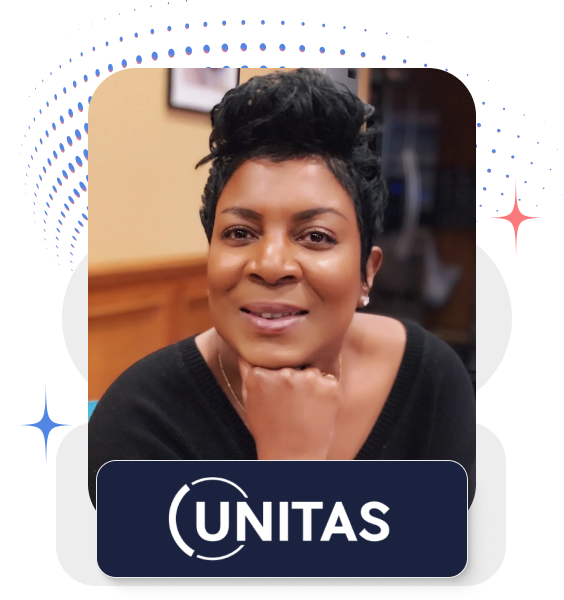
Tonya Turner, president and CEO of UNITAS North America, brings a 20-year tech background and a calling to serve women in the anti-trafficking space, following a career turning point that led her to focus on empowerment and community over purely corporate goals. Her work now centers on preventing exploitation before it happens by training the adults and systems around young people, not just reacting after the harm is done.
Since 2016, UNITAS’s award‑winning curriculum has reached over 200,000 youth and 300,000 professionals, giving schools and youth‑serving organizations practical tools to recognize grooming, coercion, and abuse, framing trafficking clearly as child abuse rather than “bad choices” by teens. Under Tonya’s leadership, UNITAS has secured a major contract with the New York City Department of Education, demonstrating its ability to scale programming across entire school systems and show measurable outcomes with both youth and professionals.
Tonya is guiding UNITAS through a growth phase, aiming to increase annual revenue from about $300,000 to $3–5 million by 2027, rebuilding after losing a founder‑linked federal grant by focusing on high‑net‑worth donors, corporate partnerships, and grassroots support. She emphasizes transparent governance and strong fiscal accountability, knowing this matters deeply to partners and funders, and cites milestones such as a Gold Webby Award and ringing the NASDAQ bell as evidence of a strong, recognized track record.
Learn More - https://www.unitas.ngo/
Amanda Finger & Laboratory to Combat Human Trafficking (LCHT): Interdisciplinary Anti-Trafficking Lab

Amanda Finger leads the Laboratory to Combat Human Trafficking (LCHT) in Colorado with a research-driven, statewide approach to human trafficking prevention and response. Her human rights journey began with women's rights and anti-violence work, evolving into comprehensive anti-trafficking efforts as the issue gained international and federal definition. The "laboratory" name reflects their experimental mindset: testing solutions through research, then sharing replicable models with communities nationwide.
LCHT serves as Colorado's hub for research, training, and support services, addressing root causes through data collection and partnerships. Their hotline fields ~1,000 calls/texts annually, connecting victims to services while nonprofits fill gaps left by shifting federal priorities. Amanda emphasizes interdisciplinary collaboration, local coalitions, national networks, and immigration support, positioning LCHT as a trusted intermediary between communities and systems amid technological change and policy flux.
Sustainability demands adaptability: balancing mission integrity with external shifts such as grant cycles and community concerns. Nonprofits excel as "safety nets and listening devices," building trust where governments struggle, especially with vulnerable populations navigating immigration or digital exploitation.
Amanda's leadership prioritizes listening and strategic alignment with communities, blending a long-term vision for social change with immediate action. She fosters environments where teams evolve through trust, positioning LCHT to innovate while serving Colorado's trafficking ecosystem effectively.
Learn More - https://combathumantrafficking.org/
Felicia Womack & Wake Up Brother: Mobilizing Men to End Violence Against Women

Felicia Womack founded Wake Up Brother after surviving domestic violence, rape, and a femicide attempt. She now channels that experience into advocacy against men’s violence against women. Now a Swedish-American activist fluent in multiple languages with diplomacy and research experience, she drives a global push for the Swedish Model (Abolitionist/Nordic/Equality Model), which criminalizes sex buying while decriminalizing sellers to cut demand and protect victims.
In line with the Swedish Model, Wake Up Brother reframes prostitution as a form of men's violence against women, linking it inseparably to trafficking, pornography, and abuse. Key efforts include high-profile events like 2025 panels in New York (with Swedish Consulate) and Washington, D.C. (Swedish Embassy), marking Sweden’s Sex Purchase Act’s 25th anniversary and celebrated Maine becoming the first state in the U.S. to adopt a version of this law, part of a wave now in 9 countries plus EU momentum.
Despite the challenges of being an immigrant—no network, not familiar with the legal or cultural context, facing language barriers, and fighting imposter syndrome—Felicia has built a powerful board, including former overcame Swedish Chancellor of Justice Anna Skarhed, Ambassador Per-Anders Sunesson, Professor Emeritus Sven-Axel Månsson, and survivor-activist Andrea Heinz among others. They produce opinion pieces (e.g., ETC Sweden), research (porn/prostitution harms), and speeches on the Swedish Model’s successes, porn’s dangers, and talking to kids about empathy and exploitation.
In the early stages post-2024 launch, Felicia prioritizes events (next at UN Commission on the Status of Women (CSW)), curriculum development, and social media with male role models, aiming for abolitionist laws worldwide amid UN calls to end prostitution systems of violence. Her leadership blends resilience with outreach to influential allies, turning survivor anger into hope through education and policy change.
Learn More - https://wakeupbrother.org/
Stephanie Olson & Set Me Free Project: Prevention Before It Starts

Stephanie Olson, CEO and founder of the Set Me Free Project, is a survivor of sexual and domestic violence who pivoted to prevention after realizing reactive rescue work left too many vulnerable. Her mission: stop human trafficking before it starts by equipping all ages, from kindergarteners to adults, with age‑appropriate education on risks like grooming, social media exploitation, consent, and coercion.
The organization’s READY to Stand Curriculum® uses engaging, learner‑centered methods (e.g., humor, interactive formats) developed with educators and experts and overhauled annually based on data to stay ahead of trafficking trends. Programs reach ~10,000 individuals across 10 states through in-person trainings (4–5 facilitators per district/agency), webinars, online courses, and a new college-chapter-initiative training program that prepares students to respond to sexual violence and human trafficking.
Funding for the organization comes from private grants, individual donors, curriculum sales, and corporate sponsors, though recent shifts in grant priorities have tightened resources. Stephanie provides ongoing support, webinars, data tools, and recertification to ensure lasting impact, with national reach and global expansion plans.
Her leadership emphasizes empowerment and letting go: hiring strong teams, giving them autonomy, and focusing on outcomes over control. From survivor to preventer, Stephanie’s work builds skills for a safer future, one classroom at a time.
Learn More - https://www.setmefreeproject.net/
Nate Alcorn & Alabaster Jar Project: Long-Term Healing for Trafficking Survivors
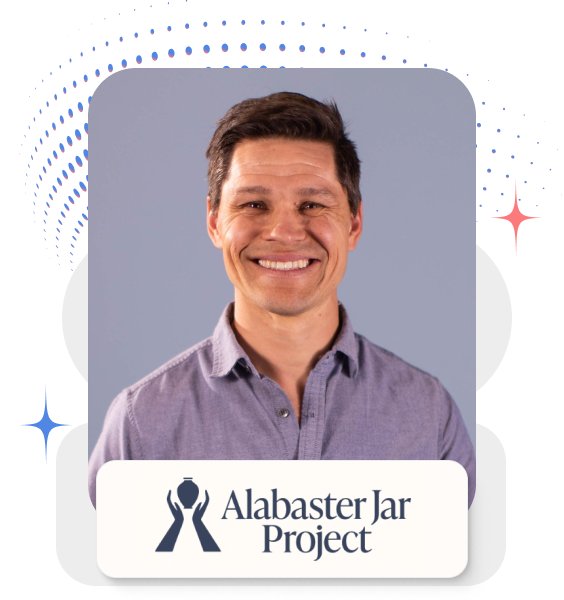
Nate cofounded Alabaster Jar and serves on the board (AJP) in San Diego, one of the nation's top 13 hotspots for domestic trafficking, generating ~$810M annually, with 80% of victims American (average recruitment age 15). Motivated by global travels revealing trafficking's ubiquity, Nate stepped up when local law enforcement flagged a gap: very little long-term homes for trafficked women akin to those for domestic violence survivors.
AJP provides holistic, long-term support via Grace House (a 2-year residential program with phases of wraparound services: legal, therapy, job training), Resource Center (crisis/recovery aid like clothing, food, transport), and survivor-led peer support groups. many of the staff are survivor themselves driving a very high success rate of women transitioning to a healthy next step. They've helped 1,000+ women, with 40–50 graduates over 12 years.
Funding mix includes local/city grants, individual donors, and events (golf tournaments, galas); Nate is evaluating social enterprises, such as scaling a women's beauty product line for hotels. Amid high recidivism, AJP's survivor leadership and community focus sustain impact in a collaborative anti-trafficking region.
Nate’s leadership stresses human connections: building a network of like-minded, action oriented individuals, empowering marginalized people to lead, and responding quickly to the needs of our community. AJP proves long-term care, led by those who've walked the path, changes lives for good.
Learn More - https://www.alabasterjarproject.org/
Becky Rasmussen & Call to Freedom: Christ-Centered Healing for Survivors
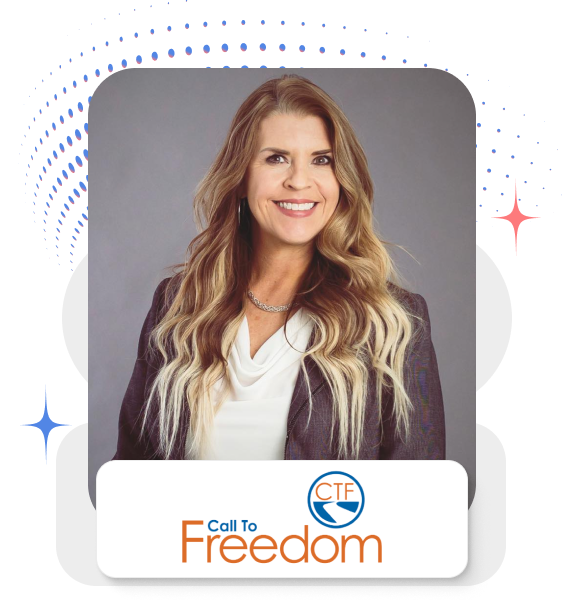
Becky Rasmussen founded Call to Freedom in 2016 after spotting a potential trafficking victim at South Dakota's Sturgis Rally, driven by her faith to fill service gaps for survivors. Now a 10-year nonprofit, it offers a Continuum of Care Model with prevention (community education), intervention (trauma‑informed training), and restoration (survivor housing/support).
Marissa's House (opened 2016) provides safe housing. A 2021 expansion added 12 units, bringing the total to 36, enabling mother‑child reunifications through therapy, job training, and case management. Faith‑infused and survivor‑informed, they've served 1,800+ individuals (ages 2–75) despite high recidivism risks.
Funding started grant-heavy but evolved strategically: local/city support covers core operations, individual donors provide flexible dollars for urgent needs, and events like golf tournaments/galas build community buy-in while celebrating survivor milestones. Becky balances transparency (through detailed impact reports) with staff well-being, preventing burnout in a high-stakes field.
Her leadership builds solid foundations: slow growth, prioritizing administrative and volunteer strengths, community needs first, and Christ‑centered wholeness. Plans include replicating the model elsewhere once SD's ecosystem is rock-solid, demonstrating that specialized care changes trajectories over the long term.
Learn More - https://calltofreedom.org/
Lessons from the Leaders
These profiles reveal shared strategies amid diverse tactics, offering readers practical insights into effective anti-trafficking work.
- Leaders prioritize prevention, delivering early education through age-appropriate curricula for children and adults, and equipping employers with tools that reduce risk before harm occurs. This proactive approach, whether training kindergarteners on grooming or corporate staff on labor trafficking indicators, prevents exploitation at its root rather than reacting after trauma.
- They scale impact through systems, securing contracts with major school districts such as the NYC DOE and in high-risk sectors such as agriculture and hospitality. These partnerships amplify reach far beyond one-off workshops, embedding anti-trafficking measures into daily operations where vulnerability meets opportunity.
- Survivor leadership drives outsized results: organizations staffing 70%+ survivors achieve 89% success rates, compared with the national 50%. Lived experience informs everything from curriculum design to peer support, building trust that turns skeptics into advocates.
- Smart funding diversification sustains missions over the long term by blending grants, curriculum sales, corporate contracts, and community events. For readers raising awareness, this shows that transparency about impact (detailed reports, milestones such as Webby Awards) attracts diverse supporters, helping your cause weather grant cuts or donor shifts.
- Collaboration trumps competition, with leaders building networks that bridge communities, governments, and businesses. Nonprofits act as trusted intermediaries, connecting vulnerable groups to systems while sharing replicable models—proving collective action multiplies impact exponentially.
What You Can Do
- Spot the signs of trafficking in everyday settings: look for isolation from friends/family, someone controlling a person's documents/money, physical branding, or sudden displays of wealth/behavior changes. Report anonymously to the National Human Trafficking Hotline at 1-888-373-7888; your call may trigger a rescue or access to services.
- Support proven organizations directly by donating, requesting workplace trainings, or advocating for school mandates and corporate anti-trafficking policies. Even small actions, such as sharing these leaders' stories, amplify their reach and sustain critical prevention work.
- Build stronger connections with at-risk youth in your community, such as foster youth, runaways, or LGBTQ+ teens who traffickers target most.
- Host awareness events at churches, PTAs, or civic groups; simple conversations about online safety and grooming save lives.
- If you employ others, lead ethically by screening job applicants for trafficking red flags, prioritizing survivor hiring, and training all staff to recognize and respond to exploitation. Businesses represent the front lines where trafficking intersects daily work.
This January, during National Human Trafficking Prevention Month, let these leaders inspire your next step. Whether spotting signs in your community, supporting survivor programs, or demanding better from employers and schools, every action disrupts exploitation. Join the fight - stronger connections truly build stronger futures.
Ready to leave your footprints?
Talk to the team that has helped 1,200+ organizations such as yours run amazing virtual & hybrid races.